Plain answers about AI search.
One question per page, answered the way we would want an engine to answer it: the short version first, the reasoning after, and a source on every number. Dated measurements live in Research.

What should an AI visibility audit of a financial institution include?
An AI visibility audit of a financial institution should include five things: a fixed list of real customer questions, a defined set of AI engines, repeated dated runs of each question, a clear definition of named versus recommended versus merely mentioned, and a report a colleague can read without you in the room. You can run the whole audit by hand with a spreadsheet.
Updated 10/18/2026
How AI search works
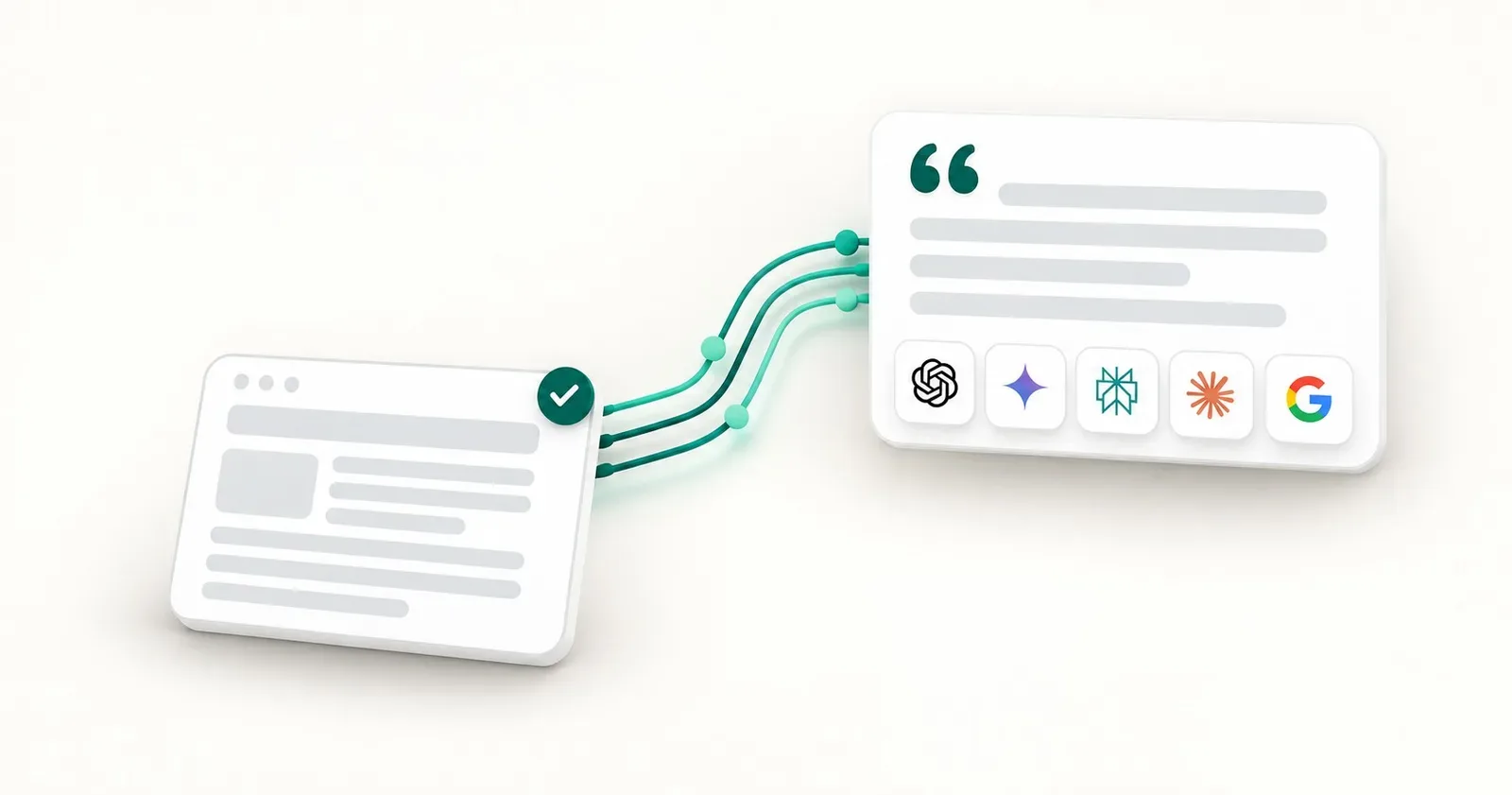
What does SEO for banks look like when AI answers come first?
Bank SEO still starts with the fundamentals: pages search engines can crawl, index, and understand. Google says those best practices remain relevant for AI Overviews and AI Mode, and no special file or schema is required. No technical step guarantees placement; check indexing, state facts in text, and measure whether AI engines name you.
Updated 10/18/2026
How should a credit union approach SEO when members ask AI first?
Credit union SEO now has two audiences: the member who searches and the AI assistant that answers for them. Google says the usual SEO best practices remain relevant, and no special AI markup is required. What changes is the standard: rates, eligibility, and branch facts must be clear, current, dated, and readable in ordinary HTML.
Updated 10/15/2026
How do Google AI Overviews decide which banks to mention?
Google does not publish a selection method for AI Overviews, and inclusion is never promised. What Google does say: AI Overviews use relevant links, may run query fan-out across subtopics, and require no special optimizations beyond helpful, reliable, people-first content. For banks, trust matters most because money questions affect financial stability.
Updated 10/13/2026
How can a bank or credit union get recommended by ChatGPT?
ChatGPT recommends a bank when its content is crawlable, quotable, and specific. OAI-SearchBot must be allowed in robots.txt, or the site will not appear in ChatGPT search answers. Then write rates and fees as plain text with dates. There is no guarantee, but you can verify access and test real prompts.
Updated 10/13/2026
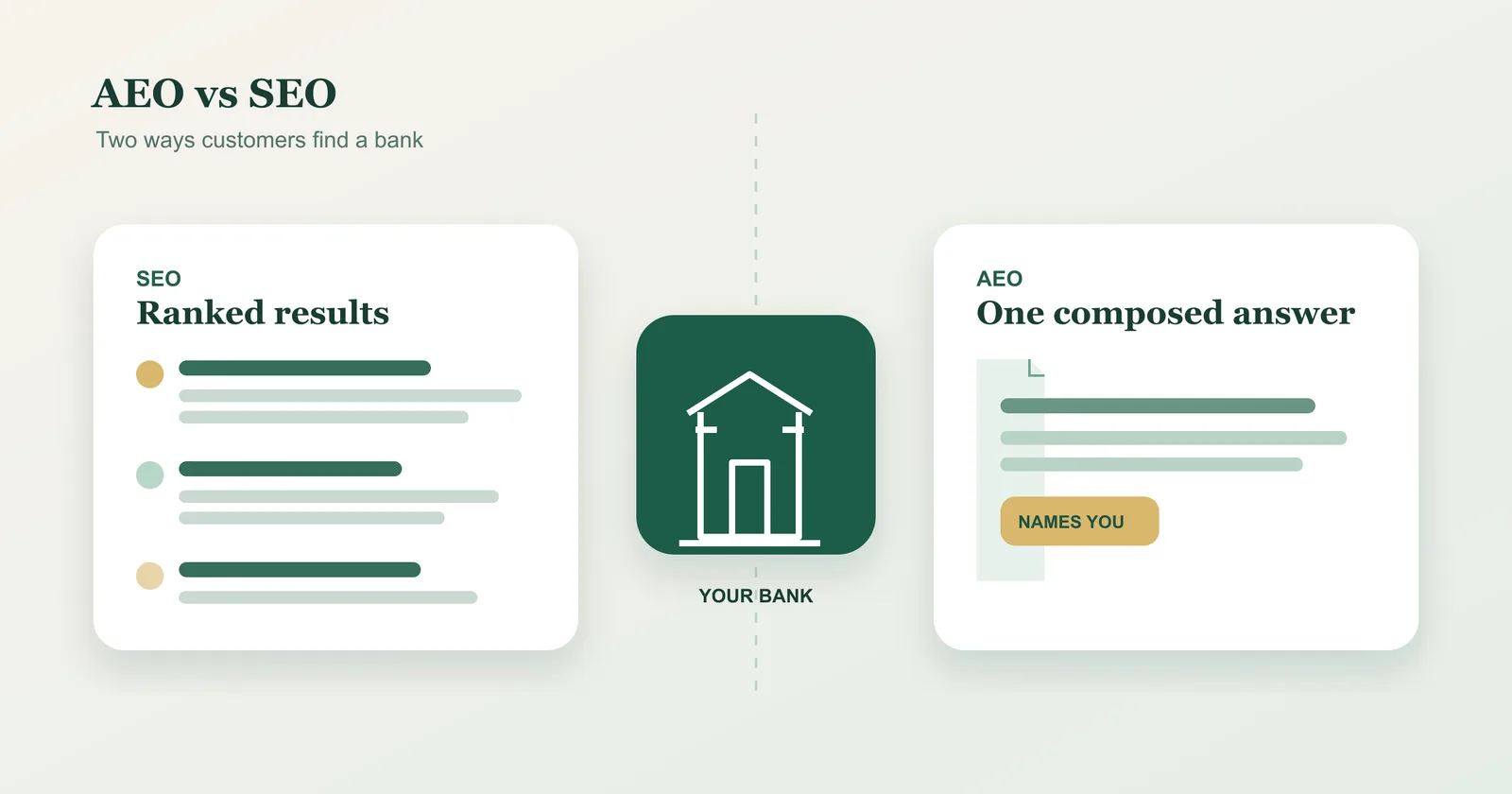
What is the difference between AEO and SEO?
SEO earns rankings on a page of links; AEO (answer engine optimization) earns citations inside the single answer an AI assistant writes. The disciplines overlap in foundations, but they differ in what is measured, what gets fixed, and who you are competing with, because a generated answer names only two or three providers where a results page listed ten.
Updated 10/7/2026
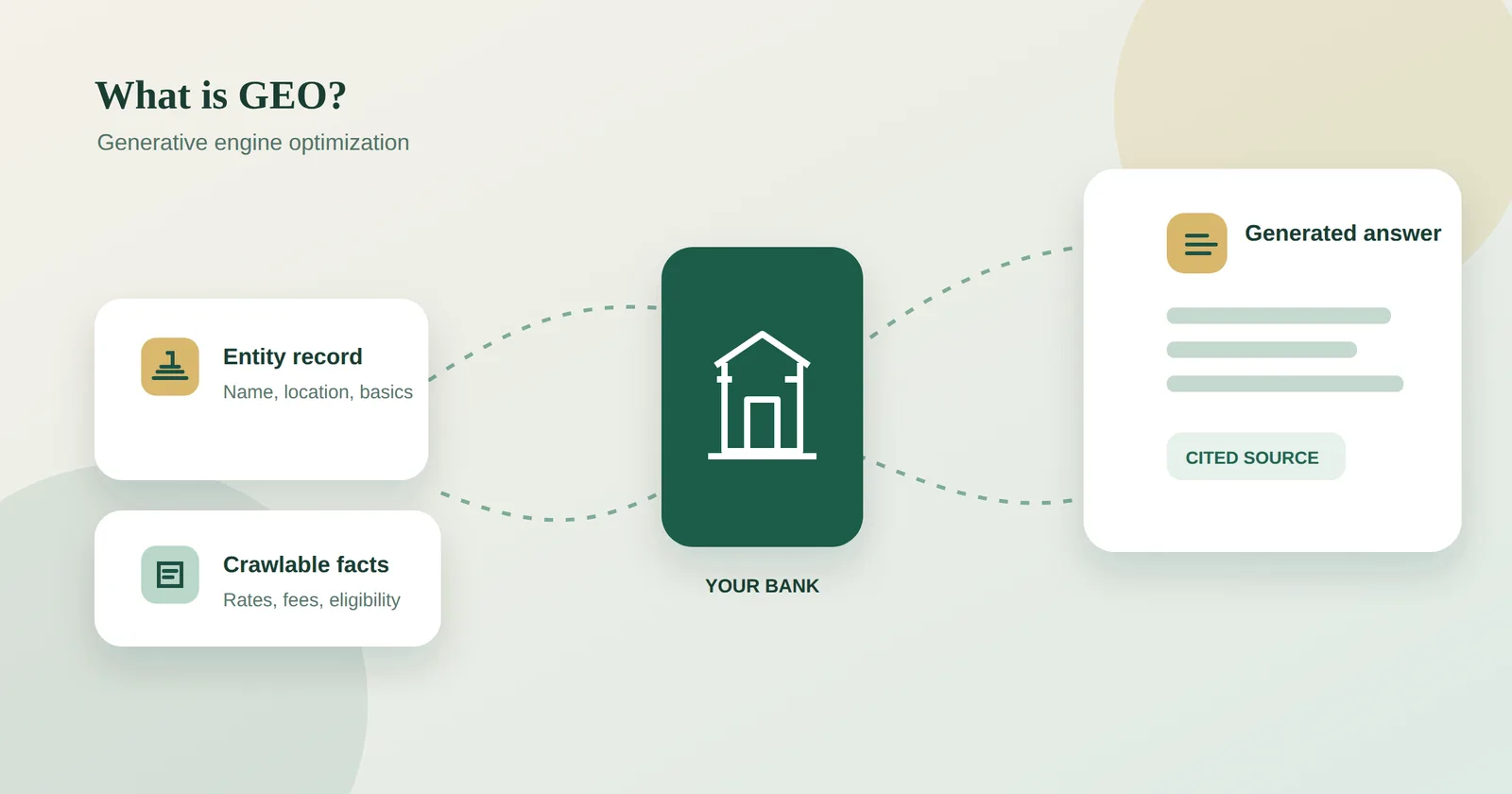
What is GEO (generative engine optimization)?
GEO, generative engine optimization, is the work of earning citations inside the answers AI assistants generate, so that when someone asks ChatGPT, Gemini, Perplexity, Claude, or Google's AI where to find something, the answer names you. It is the same discipline as AEO (answer engine optimization); GEO is more common in research writing, AEO in marketing teams.
Updated 10/7/2026
For financial firms
What is answer engine optimization for banks?
Answer engine optimization for banks is the work of making your institution easy for AI assistants to find, read, and name when people ask money questions. It rests on ordinary fundamentals: pages that are indexed, facts written in text with dates, and answers worth quoting. Google says no special structured data is required.
Updated 10/6/2026
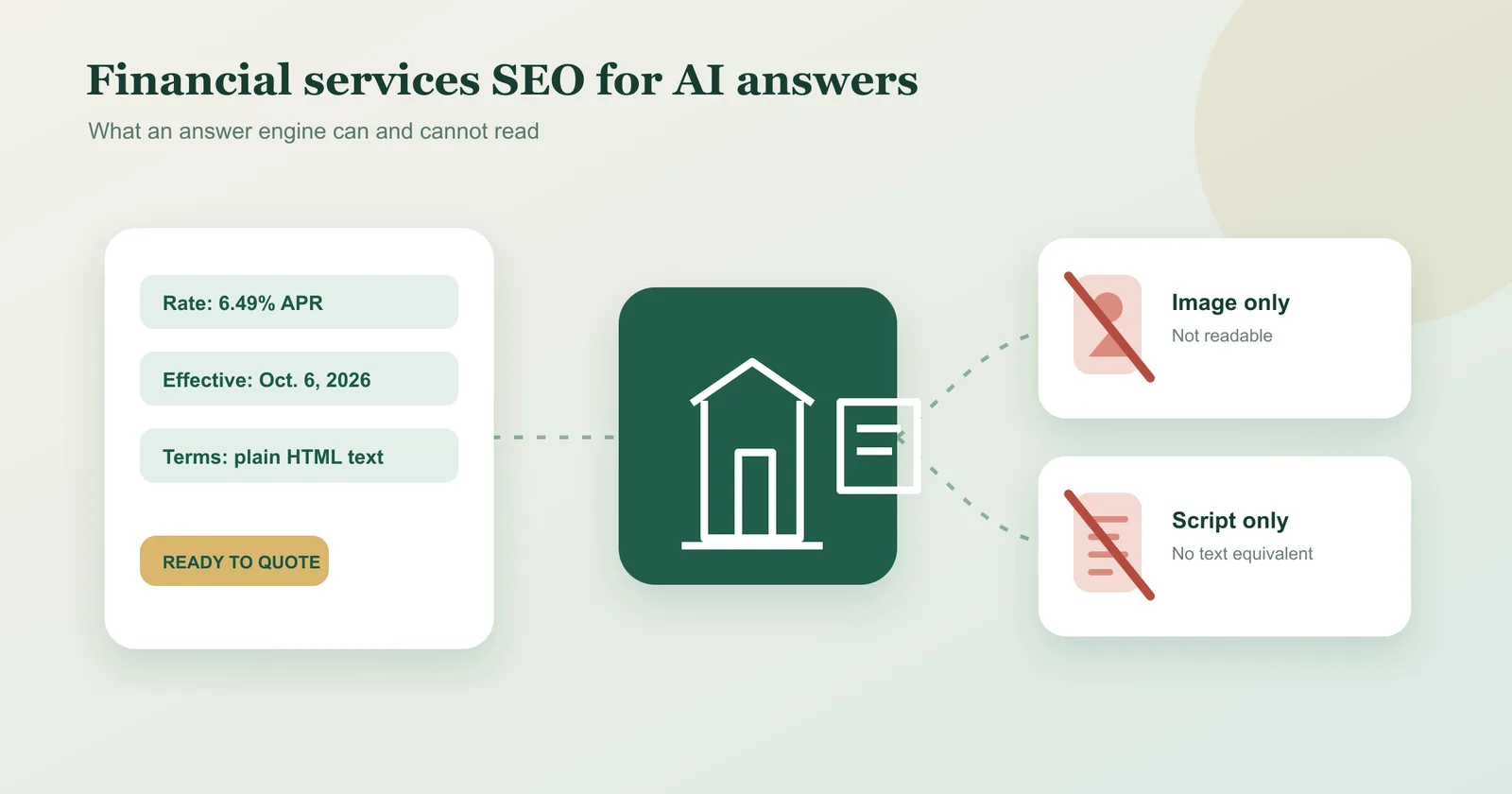
Financial Services SEO: What Answer Engines Cannot Find on Your Site
Financial services SEO now includes whether AI answer engines can read your rates, fees, and effective dates at all. When those figures sit in an image, a table with no text equivalent, or a script, the engine cannot quote them, so the answer names a competitor it can read. The fix is to put those facts in plain text and check the engines again on a later date.
Updated 10/7/2026
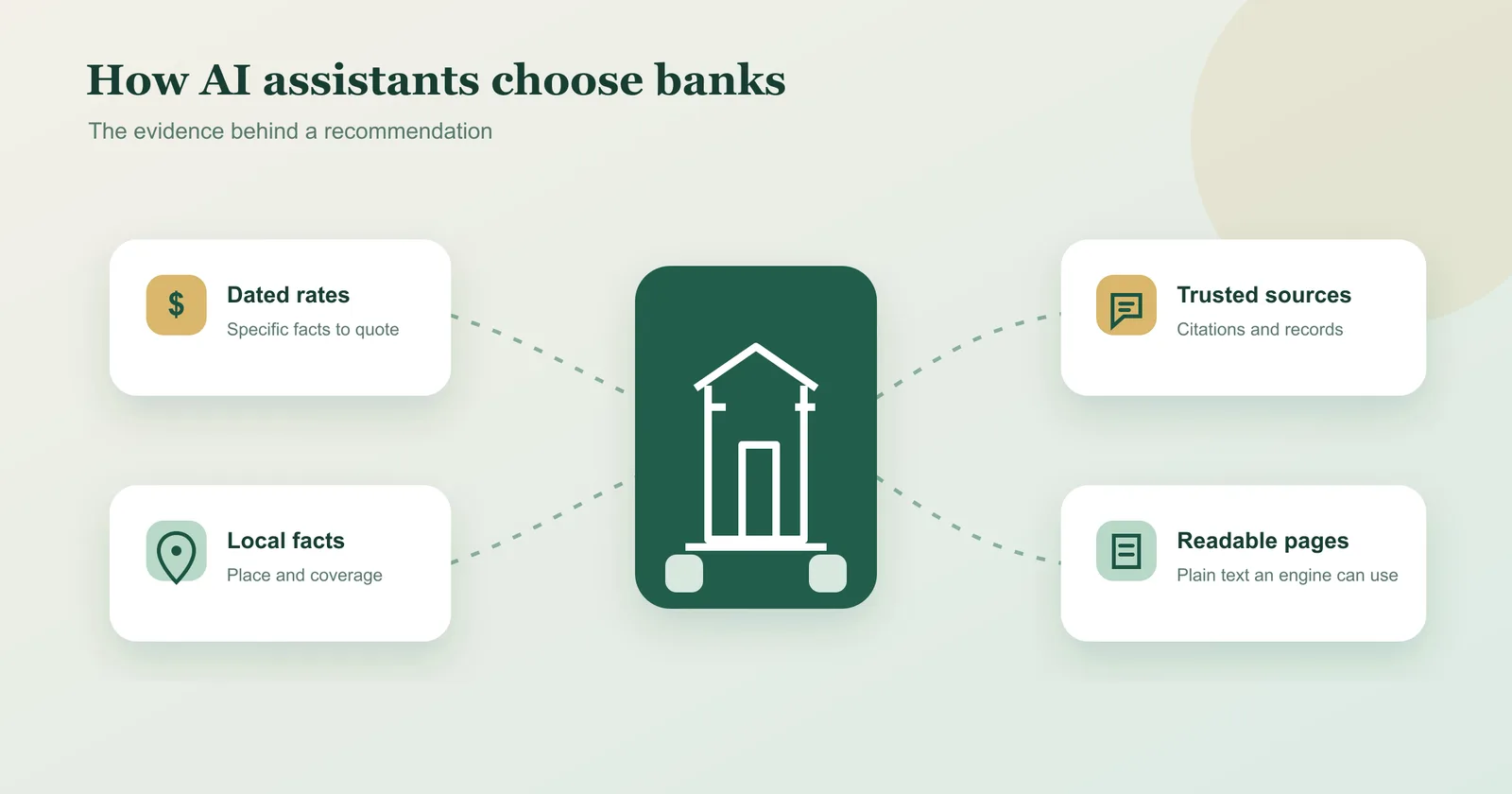
How do AI assistants choose which banks and credit unions to recommend?
AI assistants assemble banking recommendations from what they can read and verify: the institution's own pages, the web's records about it, and the comparison pages and local sources they trust for the category. They name institutions whose facts are easy to quote, so clear rate pages, consistent entity records, and presence in cited sources decide who appears more than size or ad spend.
Updated 10/7/2026