How do AI assistants choose which banks and credit unions to recommend?
By Scanley Research Team · ·
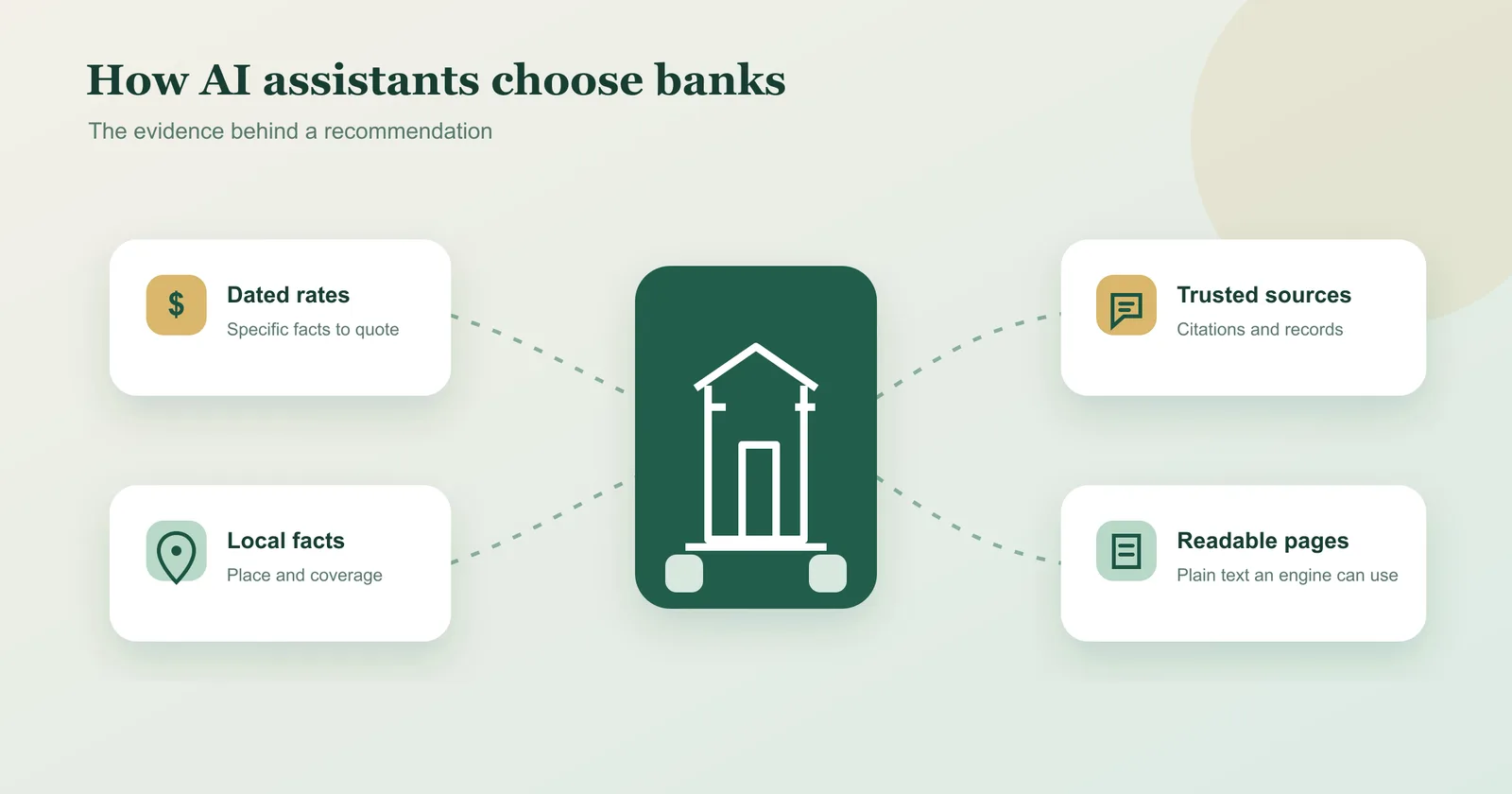
AI assistants assemble banking recommendations from what they can read and verify: the institution's own pages, the web's records about it, and the comparison pages and local sources they trust for the category. They name institutions whose facts are easy to quote, so clear rate pages, consistent entity records, and presence in cited sources decide who appears more than size or ad spend.
What the engines are doing
When someone asks where to get an auto loan in their city, an assistant is not consulting a secret ranking of banks. It is composing an answer from evidence: pages it has crawled, records it holds about local institutions, and, for engines that search live, whatever sources come back for that question in that metro. Institutions it can describe confidently, with a rate, a product name, a location, get named. Institutions whose facts it cannot pin down get skipped, however good their offer is.
This is why the same question can produce different answers on different engines, and different answers on different days. Each engine holds different evidence and weighs it differently. Any serious visibility claim has to say which engine, which day, and how many runs, which is how we report every number.
What decides who gets named
Three things dominate. Whether your rates and products exist as plain, dated text on pages an engine can read, because a model cannot quote a rate that lives inside an image or a JavaScript widget. Whether the web's records agree on who you are: one entity, one name, consistent basics everywhere your institution appears. And whether the sources engines already lean on for your category and metro, comparison pages, local roundups, review profiles, include you at all.
Notice what is absent from that list: charter and size. The engines have no preference between a bank and a credit union. In our Tulsa measurement, the answer to the best auto loan rates question quoted five local credit unions by name, with rates, and no bank. Measured August 2026 on Perplexity, logged out, method published with every scan. The institutions that won had simply made their rates quotable.
What to do about it
Start by measuring, not guessing. Run the questions your market actually asks across the engines that matter and see who is being named today; the pattern of misses tells you which of the three factors above is failing. That measurement is exactly what our free AI scan does for a single institution and metro, and it is the baseline every fix afterward is judged against.