How do you track which banks ChatGPT and Perplexity cite?
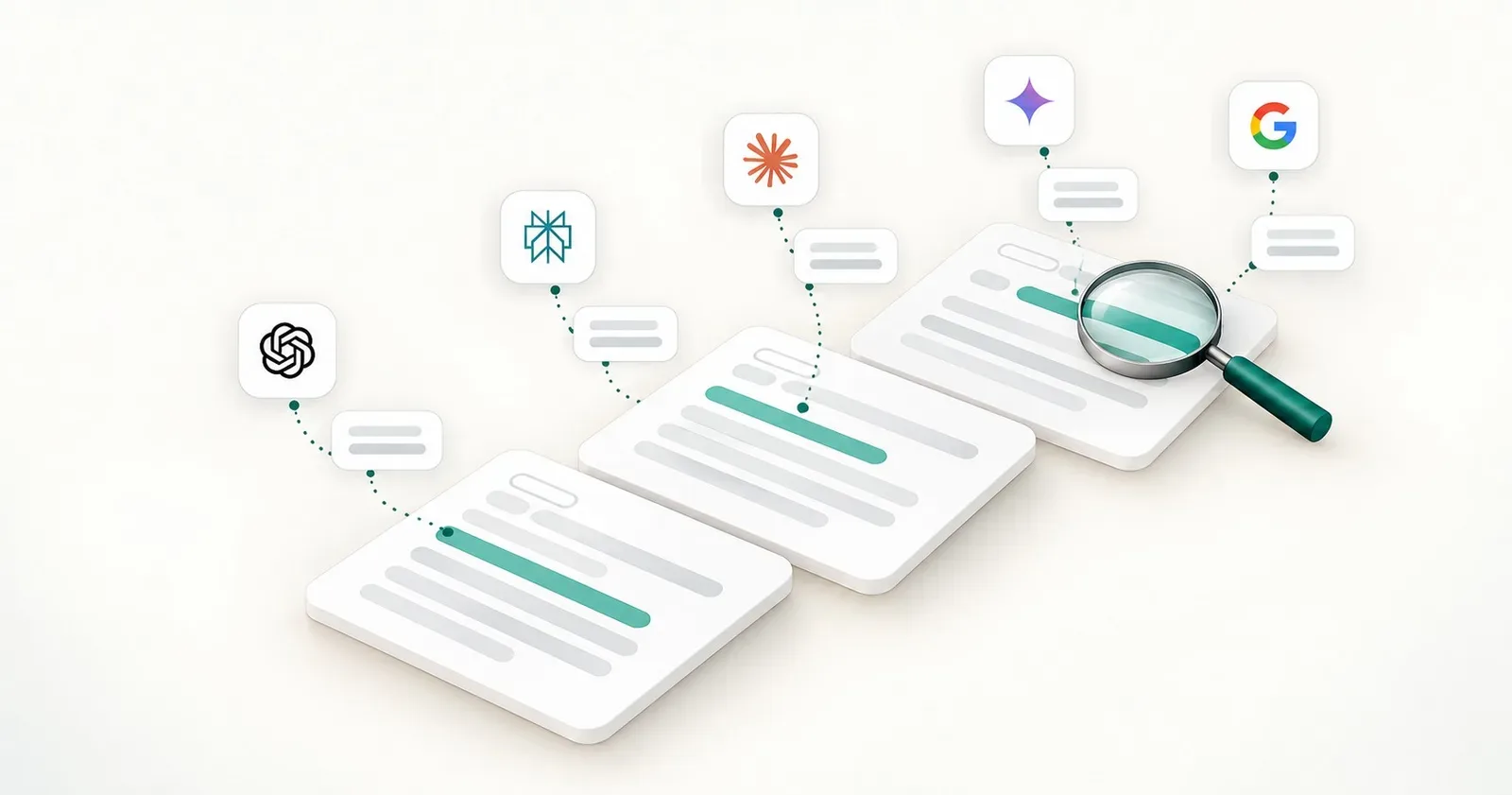
AI citation tracking is recording when ChatGPT, Perplexity, and similar assistants name your institution and which sources they cite. You can start by hand: ask the same customer questions in a fresh session, record whether your bank appears, and save any linked sources. Treat each run as one dated sample, since one check shows what an engine said that day, not what it usually says.
The short version
Ask the questions a customer would ask. Open a fresh session in ChatGPT, type something like "best checking account for a small business in Ohio" or "which credit unions near Denver offer shared branching," and read the answer closely. Note three things: whether your institution is named, whether a competitor is, and which sources the answer points to. That is a manual AI citation tracking check, and it is the foundation everything else builds on.
What the engines hand back
An answer engine does not hand back a list to browse. It composes a response, often naming only a handful of institutions, and the question is decided inside that response. This is why checking by looking at your own website traffic misses the whole event. There is no alert when it happens: your rankings look fine, your traffic looks normal, and the question gets decided without you.
Both major engines can attach sources to their answers, and those attachments are your record. OpenAI documents that web search can provide answers with sourced citations, and that its web-search responses include inline citations for URLs from web search results. Perplexity documents that its Search API returns real-time ranked web results as structured data, and it directs users who want an LLM-generated answer with citations to its Agent API. In the consumer products, citations often appear as linked footnotes or a sources list under the answer. When they appear, save them.
How to run one manual check
Keep it small enough to repeat.
Pick five to ten questions your customers actually ask. Include your product types and your geography, for example "best savings account in Austin" or "Fresno credit union auto loan.".
Open a fresh session for each question so earlier conversation does not shape the answer.
Ask the question verbatim in ChatGPT, then in Perplexity.
Record the date, the engine, the exact question, whether your institution was named, which competitors were named, and every source the answer cited.
Screenshot the answer. Engines change, and a screenshot is the only version you can return to.
A plain spreadsheet handles all of this. One row per question per engine per date.
Why the citations matter more than the mention
The mention is the outcome. The citation is the explanation. When an answer links to a source, it is showing you what it read to decide who to name. If the engine cites a roundup article on a third-party site and not your own product page, that tells you where it found its facts. If it cites your page but names a competitor, the facts on your page may be incomplete, undated, or trapped in an image where the engine cannot read them.
So each citation deserves a follow-up question: is this source accurate, current, and complete on the facts a customer would compare, like rates with effective dates, fee amounts, eligibility, and service area? Rates and fees change, and regulated content like disclosures deserves a careful eye whenever you update it. But the checking itself needs no new tooling, only attention.
One check is one dated sample
Answers vary. The same question asked twice can name different institutions, and a question asked in March can produce a different answer in May. A single run tells you what an engine said to one session on one date. It does not tell you whether you are usually named, usually absent, or moving in either direction.
This is the discipline AI citation tracking actually requires: repeat the identical question set on a schedule, keep the dated samples together, and look at the pattern across runs rather than any single result. Weekly or monthly cadence works for a small question set. When you spot a change, compare the cited sources across dates. A shift in citations usually precedes or explains a shift in mentions.
When manual checking runs out
The manual method covers a handful of questions across two engines. It strains when you want more question variants, more engines, or a longer history, because the cost is your time and the risk is inconsistent records. That is where measurement tools earn their place. Scanley measures this across the AI engines and keeps the dated samples in one place, but the manual check described above is free, takes an afternoon, and gives you a defensible starting picture today.
If the check shows your institution absent from questions it should answer, the next step is examining what the engines can read about you: your product pages, your facts, and the third-party sources they rely on. Our guidance for credit unions and community banks covers what those institutions can check and fix on their own pages.
Questions people ask
How do I check whether ChatGPT mentions my bank?
Open a fresh session, ask a question a customer would ask, and read the answer. Record the date, the exact question, and whether you or a competitor were named. A screenshot preserves the result, since the same question can get a different answer another day.
What is a citation in an AI answer?
It is a linked source the engine used to build its response, often shown as a footnote or sources list. OpenAI documents inline citations for web search results, and Perplexity's products show sources alongside answers. The citation tells you what the engine read, which is often more useful than the mention itself.
Is one check enough to know where I stand?
No. One check is one dated sample from one session. Answers vary between runs and over time, so a trend requires repeating the same question set on a schedule and comparing across dates.
How often should I rerun the check?
Weekly or monthly works for a small, fixed question set. The questions must stay identical across runs, otherwise you cannot compare dates. Consistency of the method matters more than frequency.
What should I do if the engines cite sources that are wrong about us?
Identify which facts are wrong and where the engine found them. If a third-party roundup is the cited source, your own pages need to carry those facts clearly, in text, with effective dates. Fix first on the pages you control.